
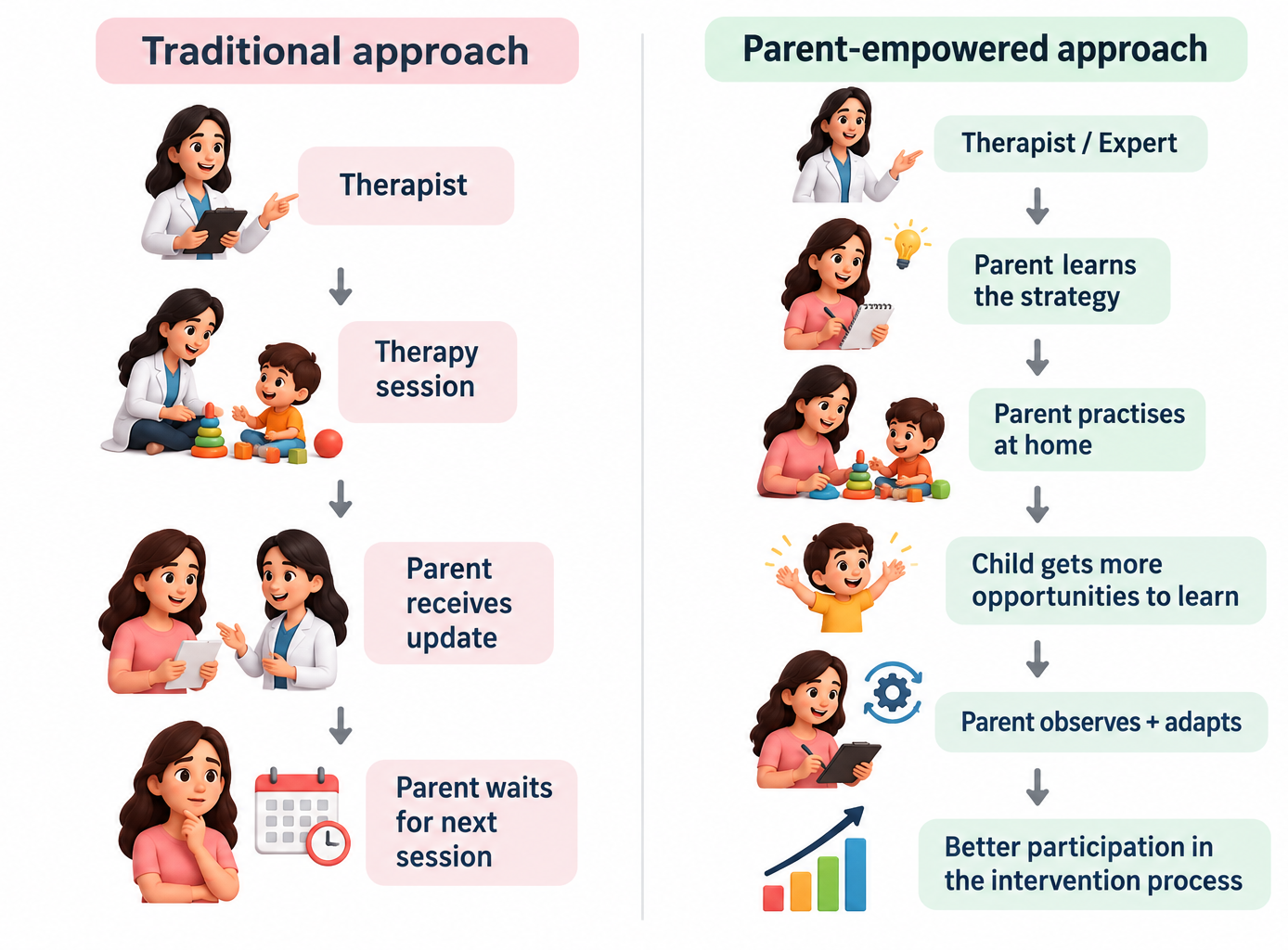
Understand how to create everyday opportunities for communication rather than simply asking your child to speak.
Learn practical ways to support understanding and expressive language during daily
routines.
Learn to look at what may be happening behind the behaviour and how your response can support learning.
Learn how everyday activities can become opportunities to build participation and independence.
Understand how play, routines, meals, dressing, outings and other ordinary moments can become learning opportunities.
Learn how to become a more informed participant in your child's intervention journey — not just someone who receives updates.

You don't just receive information. You learn how to apply it.
The focus extends into the everyday moments between therapy sessions.
Learn approaches that can be incorporated into ordinary routines.
Learn to ask: “Why isn't this working for my child?” rather than simply repeating the same strategy.
Communication, language, behaviour, learning and independence are considered together.
No miracle cures. No unrealistic guarantees. No “one technique works for every child.”

Learn directly from Shweta.
Take-home resources/checklists/workbooks.
Understand how strategies can be applied to everyday situations.
Leave with specific things you can start practising at home.

Identify more meaningful learning opportunities in everyday routines.
Think about communication beyond spoken words.
Respond to challenging situations more thoughtfully.
Break everyday skills into manageable teaching steps.
Work more confidently alongside therapists and other professionals.
Leave with practical strategies you can begin applying at home.
The Overwhelmed Parent’s Guide to Time Management
You don't need a separate hour for it. Use moments you already have, like breakfast, bath time, the walk to school or bedtime. Ten focused minutes a day is more useful than a long session you can't keep up. Pick one or two skills to practise instead of trying to cover everything.
No. Short, consistent practice usually works better than long sessions, especially if your child gets tired or resists. Every child is different, so a special educator can help you decide how much practice suits your child.
Warn your child before a change, using a timer or a visual schedule so they can see what comes next. Keep the order of the day predictable and leave extra time for transitions. If meltdowns happen often, personalised guidance can help you find what is triggering them.
Choose the one or two skills that would make daily life easiest right now, such as communicating needs, following simple instructions or managing sensory reactions. Work on those for a few weeks before adding more. A one-to-one consultation can help you set priorities for your child.
Lower the bar on tired days. A few minutes of play-based practice, or just keeping the routine going, still counts. Save the more focused activities for days or times when you have more energy, such as weekends.
Write down the week's fixed commitments first, then fit in practice around them. Combine tasks where you can. For example, reading practice can double as homework time. Drop anything that isn't essential for now.
Ask for specific tasks instead of general help. For example: "You take the morning routine" or "You do 10 minutes of reading practice after dinner." Share what you have learned about your child's needs so they know what to do and why it matters.
Learn practical strategies to support your child at home.
Seats are limited!
REGISTER NOW